I'm a professional writer and frustrated DJ who hasn't yet figured out how to use all his useless knowledge of music and pop culture for the betterment of mankind. Further questions? You can email me at playitandbedamned@gmail.com. and I promise I won't become too enraged.
All songs are for sampling purposesonly and are available online for a limited time. If the album is in print, go out and buy it and support the wonderful artists who have all made our lives a little better.
If you're the artist or copyright holder, a quick e-mail is all that is needed to remove the mp3.
Do not email me requesting the reposting of dead links or asking for a songyou cannot otherwise find. It's just rude.
Do not hotlink to the files on this site. Again, it's all matter of Internet manners
For my 100th post, which comes almost exactly six months after I launched this blog, I'm focusing on a soundtrack of rather recent vintage.
Released late last year and making barely a dent at the box office, Walk Hard: The Dewey Cox Story (2007) stopped the string of hits from producer Judd Apatow, the guy behind Knocked Up (2007) and Super Bad (2007), among other films.
Why did it flop so miserably? Well, it had a few strikes against it. It was a music-oriented movie, which can be hit or miss with the public. It wasn't that funny, despite a few clever moments. And it was a bit schizophrenic: Sophomoric and scatological one moment, obtuse and filled with sophisticated in-jokes the next. It also couldn't decide whether to make the title character likable or a total buffoon.
I also think it was too narrowly focused in its satire. Most of the jokes were take offs from Ray (2004) or Walk The Line (2005). There were so many other great musical biopics to make fun of. What about La Bamba (1987), The Doors (1991), What's Love Got To Do With It? (1993)? So many opportunities, so much wasted celluloid. Heck, the non-satirical That Thing You Do (1996) had a broader focus.
But that's not the point of today's discussion.
My favorite part of the movie was Cox's Brian Wilson phase when he decides to record the perfect song with a full orchestra, multiple sitarists, bushmen playing diggeroos and a bleating goat. Let's not forget the trampoline, substituting for the sandbox. The song itself was so Wilsonesque that it almost seemed like a Smile outtake.
I found out why when the final credits rolled. The co-writer of the song was none other than Van Dyke Parks, who actually collaborated with Wilson on Smile (and walked away when it was clear to him that Wilson was never going to finish it – at least as a Beach Boy). Play "Black Sheep" by John C. Reilly
Parks isn't the only musical hotshot on the soundtrack. Not in the slightest. Because the title track – and Cox's signature hit – was written by that paramour of power pop, Marshall Crenshaw, along with Reilly, Apatow and director Jake Kasdan. I'm surprised that the song – or any of the others on the fairly solid soundtrack – didn't at least get a Oscar nomination instead of all those craptacular songs from Enchanted (2007). Play "Walk Hard" by John C. Reilly
As a bonus, I've tacked on one of my favorite scenes from the movie: Cox conversing with the four "Beatles" and contributing mightily to their eventual break-up. Paul Rudd as John Lennon is a real hoot.
In the late 1980s, everybody was trying to get into the act.
Even those who had no business being there.
I'm talking, of course, about the easy money record companies were making by releasing soundtracks in conjunction with hit films.
There was a big caveat: The film had to be a hit.
And it wouldn't hurt if the record company knew how to do this sort of thing.
None of the above applied to Under Cover (1987), a fick produced by the shlockmeisters of the time Menachem Golan and Yoram Globus. It was designed to cash in on the craze for John Hughes/Cameron Crowe-type teen flicks – with a splash of gritty realism thrown in for good measure.
Directed and co-written by John Stockwell, who played one of Tom Cruise's colleagues Cougar in the smash Top Gun (1986) the year before, the movie also had as one of its co-stars Jennifer Jason Leigh of Fast Times at Ridgemont High (1982) to boost its marketability.
Didn't matter. The movie made barely a dent in anyone's consciousness.
So why am I writing about this film?
Partly because of the company that released the soundtrack: Enigma Records was one of the great indie labels of the 80s alternative scene. If you were a college radio music director back then, you listened seriously to almost anything they sent you: Game Theory, Green on Red, Don Dixon, etc. This was also the label that launched the careers of the Red Hot Chili Peppers, the Smithereens and (unfortunately) Poison.
Super-slick 80s soundtracks weren't their thing, however.
Until this one, which truth be told wasn't particularly slick. On one side were the instrumentals composed for the movie by the composer of it score, the one and only Todd Rundgren.
On the other side were five tracks from three Enigma artists: TSOL, Agent Orange and Wednesday Week.
Which brings me to the whole point of this post: To reintroduce the world to the single from the soundtrack, "Missionary" by Wednesday Week, a criminally overlooked piece of 80s power pop from a band that was unfairly compared to the Bangles.
This group – which did have a male among its four members – had a slightly harder edge. In this song particularly, I love how they fuse the garage band guitars into a song that has more hooks than a deluxe fishing lure.
Rightfully so, Cameron Crowe and John Hughes receive lots of praise about their choice of music and how they weave it into their films.
But there's one other director I admire for the way he uses music to add extra dimensions to his work: Barry Levinson, particularly in his early films.
Can anyone imagine his directorial debut Diner (1982) without the mind-boggling assortment of 50s tunes that helps define the film's setting? Or how about the way Randy Newman's music in The Natural (1984) builds the tension and, eventually, brings out the joyfulness of the film's climactic scene?
Perhaps Levinson's most successful film to date, and the only one for which he won a directing Oscar, is another example of how music can play a key part in the way the film unfolds. This film about an autistic savant, played famously by Dustin Hoffman, and the cross-country road trip he takes with his brother is undeniably quirky – and the selection of the songs reflect both the theme of the film and the peculiar mind of Hoffman's Raymond Babbit. I mean, you have Etta James singing "At Last," Lou Christie of "Lightnin' Strikes" fame crooning "Beyond The Blue Horizon," Banarama doing their usual goofy stuff on "Nathan Jones," early r&b contributors Delta Rhythm Boys contributing "Dry Bones" and Aaron Neville combining with iconoclastic bassist Rob Wasserman on a delicate"Stardust." The one quibble I have is the inclusion of the Belle Stars ho-hum cover of "Iko Iko," rather than the Dixie Cups' original. But that's offset by the inclusion of one of my all-time favorite songs of the 80s: Juluka's "Scatterling of Africa"
Levinson's other unorthodox contribution was the hiring of a relatively unknown German composer to do the soundtrack. Although Hans Zimmer had done a few soundtracks, he was best known as an electronica composer who had played keyboards on the Buggles' "Video Killed the Radio Star." Zimmer contributed a score that mixed elements of Stewart Copeland's rhythmic innovations with the popular electronic music of fellow German Harold Faltermeyer. The soundtrack itself included two of his instrumental tracks, "Leaving Walbrook On The Road" and "Las Vegas End Credits." Play "Leaving Walbrook On The Road" by Hans Zimmer
Rain Man won four Oscars in 1989 – including one for Zimmer's score.
But that's not the end of the story.
Zimmer, of course, was on his way to a highly successful career as one of Hollywood's top composers. Five years after Rain Man, he hooked up with Walt Disney and was hired to compose the incidental music for The Lion King (1993).
Yeah, you might have heard of that movie. The Broadway musical. And the blockbuster money-making machine.
The funny thing is, Zimmer's music didn't turn out to be so "incidental." First of all, the musician Lebo M. used it as a basis to compose many of the songs on the CD sequel Rhythm of the Pridelands (1993). And that music was, in turn, used to expand the score of Julie Taymor's Broadway production. Listen to "He Lives in You" (the original Rhythm of the Pridelands version), which has become almost as identified with The Lion King as the songs from Elton John and Tim Rice. Play "He Lives In You" by Lebo M. and Hans Zimmer
Notice any similarities? Yeah, Zimmer sort of ripped himself off.
But really, that's the life of the Hollywood composer. Right, John Williams?
Two more things to note if you are intrigued by autistic savants and other variations on the ADHD/Autism spectrum. For insight into how an autistic savant's mind works, I highly recommend that you read the autobiographical "Born on a Blue Day" by Daniel Tammet, an autistic savant who is somehow able to explain the way his brain functions to the non-autistic world.
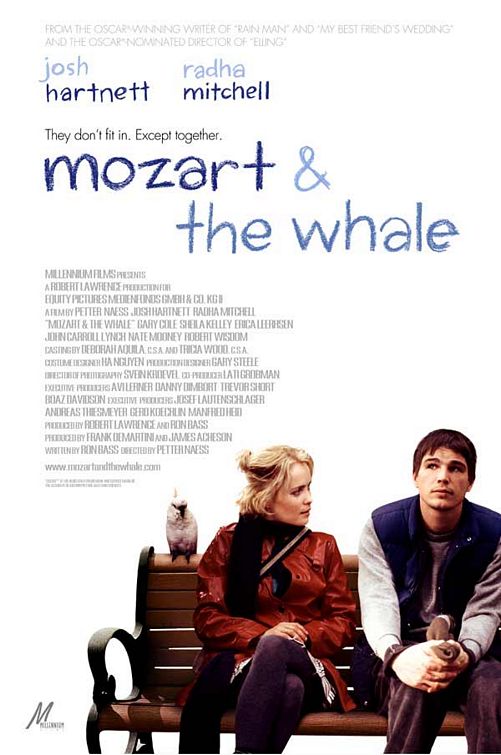
And Ronald Bass, who wrote the screenplay for Rain Man, was also behind Mozart and the Whale (2005), a love story that represents Hollywood's first mainstream attempt to portray the related but less disabling condition known as Asperger's Syndrome.
As you might remember, one of the interesting bits of trivia from last year's Across The Universe was that many of the vocals for the film's Beatles songs were recorded by the actors on the set.
Well, try this on for size: An entire film with a soundtrack that was recorded while the cameras were filming.
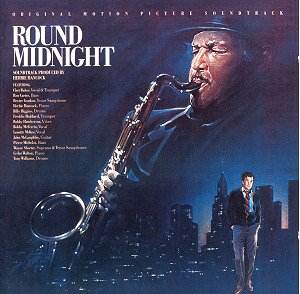
That would be Round Midnight (1986), an often forgotten masterpiece from French director Bernard Tavernier. Taking its title from the classic Thelonious Monk composition (more properly named 'Round Midnight), the movie stands out as one of the finest films ever made about jazz and the musicians who played it.
Based on the later life of pianist Bud Powell (and to a lesser extent, Lester Young), the film recounts the friendship between an aging African-American saxophonist named Dale Turner who is befriended while in Paris by a French jazz aficionado. Their relationship helps Turner, at least for a time, overcome alcoholism and the many other challenges in his life.
It's a beautiful and gentle film that I highly suggest you rent, even if you are not a big jazz fan. The sweet relationship between Turner (played by jazz great Dexter Gordon in one of his only film roles), Francis Borler (François Cluzet) and Francis' young daughter Bérangère (Gabrielle Haker) permeates every touching moment in the film. It's a real treat. The performance by Gordon, who received an Oscar nomination, has been denigrated by some of his peers as Gordon simply playing himself. But you know what? Sometimes, there's nothing harder for someone to do – particularly someone not used to having a movie camera stuck in his face.
As good as the film is, the music may be even better. Herbie Hancock won the Oscar for his score, but the real stars are an all-star line-up of jazz heavyweights. Besides Hancock himself on piano, there's Freddie Hubbard on trumpet; Wayne Shorter on saxophone; Chet Baker playing trumpet and singing an achingly beautiful "Fair Weather;" Bobby Hutcherson on vibes; John McLaughlin on guitar; Ron Carter on bass; and Tony Williams on drums, among others. Most also appear in the film in vital roles as Turner's fellow musicians.
I have many favorite tracks on the album. Hancock and Gordon's version of "The Peacocks" ranks up there with the Stan Getz and Jimmy Rowles original. The haunting "Bérangère's Nightmare" really sets the mood during one of the film's most riveting scenes. Actress and vocalist Lonette McKee (The Cotton Club) sings a smoky "How Long Has This Been Going On?" that complements the proceedings.
Yet, today, I've chosen to spotlight two songs that feature Bobby McFerrin's wordless vocals: "'Round Midnight" and "Chan's Song (Never Said)," the Hancock original that closes the movie. Of the latter, I've got to say that the inherent loveliness of this song gets me every time. For another great version of the song (with lyrics), I suggest finding Dianne Reeves' rendition on her 1991 debut.
Chan, by the way, is a reference to Chan Parker, wife of the late jazz saxophonist Charlie Parker – a tragic figure in his own way whose life has been captured on celluloid as well.
These are all composers who hit it big during the 80s with their synth-based scores.
Although he never made it to the Top 40, Michael Boddicker deserves to be added to the list – thanks to his memorable and unique score for the equally unique cult film, The Adventures of Buckaroo Banzai Across the 8th Dimension (1984), more simply known in most circles as Buckaroo Banzai.
It was one of those films you either loved or hated when it first came out. Some people couldn't get into it because of the complex plot machinations and heavy pseudo-scientific devices (Beings from the 8th dimension? And why did some of the aliens look like Rastafarians?) I have to admit that I had to watch it a second time before I completely understood what was going on.
But that was besides the point. The film is big campy fun – kind of like a comic book for the big screen, which it was designed to resemble.
The cast also made the film entertaining by itself. What other movie includes the likes of Peter Weller, Jeff Goldbum, John Lithgow, Ellen Barkin and Christopher Lloyd? You've also got the bed-ridden President of the United States being played by Ronald Lacey, the evil Nazi in Raiders of The Lost Ark, Yakov Smirnoff as his national security adviser and Billy Vera (Mr. "At This Moment") as a member of Banzai's group, the Hong Kong Cavaliers.
To summarize it briefly: Weller is a scientist, brain surgeon, comic book hero and rock musician who needs to stop evil aliens from escaping from the 8th dimension after one of his experiments accidentally lets them loose. Inexplicably, the film ties in these aliens to the fake "War of the Worlds" radio broadcast in 1939.
Back to the music: Boddicker, a synthesizer player who worked with Michael Jackson, was hired by music coordinator Bones Howe to provide the music and some of the ambiance for the movie. His equivalent of "Axel F" came during the end credits which finds Weller and the rest of the cast walking around a dry Los Angeles aqueduct. According to IMDB, the music wasn't ready yet so Boddicker told the film's producers to blare out "Uptown Girl" by Billy Joel for the filming because it would have the same tempo.
The song for the end credits that Boddicker came up with never became a big hit (just like the film itself), but it has become almost as fondly remembered as the movie itself.
How often do you find something that combines one of your favorites from your childhood with one of your more recent favorites of your adulthood?
The answer: Not often enough.
Years ago, when my kids were smaller, the limited amount of music they would enjoy during road trips would drive me crazy. I mean, how often can you hear the Mulan (1978) soundtrack without all those Matthew Wilder songs sounding the same? And all those Barney songs used to want me to drive into the nearest ditch …
Sure, there's Schoolhouse Rock. But truthfully, that's for kids who are a little farther along in their development. Let's face it: "Conjunction junction/What's Your function" has very limited entertainment value to a kindergartener.
Fortunately, at some point, I remembered one of my favorite albums from my childhood, found a CD of it – and managed to survive the era of little musical taste.
That album? Really Rosie (1975).
The soundtrack to an animated CBS-TV special, the half-hour show brought some of Maurice Sendak's characters to prime time: The Nutshell Kids, the characters in Sendak's pre-school books, The Nutshell Library. The series of mini-books include "Pierre," "Alligators All Around," "One Was Johnny" and "Chicken Soup With Rice."
Bringing them all together was a little girl simply known as Really Rosie, who in her own words is "a great big deal." Or at least she thinks she is. Based on a little girl Sendak never personally knew but used to sketch endlessly from the window of his apartment, the author said the 10-year-old Rosie provided him with the boilerplate for his unique kid lit characters.
In the special, which Sendak wrote and directed, Rosie thinks she can become the big star that she always knew she would be by putting on a show. And she has her friends in the neighborhood audition. They audition by performing the stories in their books.
The books were great in their own right – more than worthy anchors to the Sendak collection that includes "Where The Wild Things Are." But set to the music of Carole King, they really take off. Three years after the mega-success that was Tapestry (1971), King was in the midst of slump. Nothing she had put out since then had approached the wonderfulness of that album. But with Really Rosie, Sendak must have been a near-perfect muse. Not only did she compose the songs, but she sang all of them – with her daughters Sherry and Louise Goffin providing kid backing vocals.
Truly, King and Sendak were really meant to be together: Two Jewish kids who grew up in roughly the same Brooklyn neighborhood. King knew what was needed to capture Sendak's magic with her 11 songs – 12 if you include a reprise of the title track.
To this day, in the same way some folks can't help sing the preamble the constitution when they read it, I launch into an internal chorus of "Pierre" whenever I hear someone say "I don't care."
As Sendak himself said in the liner notes to the 1999 CD reissue, King's music is "an amazing incarnation of that tough, talented street kid … She was and, of course, will always be the most Really Rosie of them all." Which is why even though "Really Rosie" has morphed into a musical theater production (Patricia Birch of Grease fame directed the original off-Broadway production, which I also saw) that is still produced by kid theater groups around the country, Rosie just ain't the same without Carole behind the mic.
Here's a treat for those who missed the original special and never saw the VHS tape (it has yet to be officially released on DVD). Someone recently posted, in three parts of ten minutes each, the entire Really Rosie special on YouTube. Yes, the animation isn't the greatest (rumors are that Sendak wasn't terribly hands-on with his direction and let others take charge of the show's look). But it truly beats a "Scooby Doo" episode any day.
Or an endlessly repeated "Barney" tape, for that matter.
I don't know why, but Love, Actually (2003) perpetually makes the list whenever I talk about my favorite movies.
Frankly, I didn't have high expectations before I watched it. The only reason I wound up seeing it was the superstar British cast (Liam Neeson, Emma Thompson, Alan Rickman, Keira Knightley, Hugh Grant) that for once wasn't up to its necks in waistcoats and pinafores. Sure, I liked Richard Curtis' Four Weddings and a Funeral (1994) and Notting Hill (1999). But this film sounded too chick flicky.
Much to my surprise, I really dug it. Sure, people have complained about too many story lines – and none of them quite deep enough. And all those neat coincidences at the end. But to me, the whole movie struck a really good balance.
Sure, all the romantic stuff was a little bit over the top. But that was the point, right? I think Curtis set out to make everything so over-the-top that you can't help but step back and laugh. Furthermore, all that sappiness was also counterbalanced by the heartbreaking story lines of Thompson and Laura Linney.
You also had to love all the slapsticky ridiculousness thrown in. After all, Curtis got his big break writing for Rowan Atkinson's Black Adder (1983-89). Vestiges of that show's silliness can be seen in the storylines involving the aging rocker played by Bill Nighy (the antithesis of the officious bureaucrat he usually plays) and the blossoming love affair of the two nude stand-ins. Yep, the chicks may lap up this stuff. But we guys know better. This Curtis guy really is a Three Stooges fan at heart.
One more thing about the film: The music.
Sure, there are a few songs that you really don't want to touch (The only reason "Wherever You Will Go" by the Calling is included is probably to drive up U.S. sales) and too many of the songs are available elsewhere. But as a whole, the 17-song collection works.
I no longer have to include Mariah Carey on any of my holiday mixes because the incredibly talented Olivia Olson blows the former Mrs. Mottola away with her version of the Carey co-written ditty, "All I Want for Christmas Is You" (Curtis says on the DVD commentary that the ten-year-old's singing was so perfect they had to ask to sing more like a kid). Play "All I Want for Christmas Is You" By Olivia Olson
The soundtrack plays like an eclectic mix tape. You have Joni Mitchell's haunting "cover" of her own "Both Sides Now," Otis Redding doing "White Christmas," the Pointer Sisters' campy classic "Jump (For My Love)" and "Songbird," a Fleetwood Mac cover from the late Eva Cassidy. Just like the movie itself, it manages to juggle the happy and the sad with aplomb.
I'm also quite fond of the score from Craig Armstrong, a Scottish musician who has quietly carved a reputation for himself as a composer of understated yet beautiful and memorable film scores. The main theme – which appropriately plays amid all the over-the-top happy endings at the film's conclusion – is a little to schmaltzy for my taste. So instead, I'll post his other score snippet on the CD, the more elegantly simple "Glasgow Love Theme."
More than that, however, I truly enjoyed the left-leaning political thrillers that emerged from Hollywood during my teenage years: Missing (1982), Under Fire (1983), The Year of Living Dangerously (1982).
Every once in a while, TV would tread into that territory – most notably Miami Vice, which produced a harrowing episode called "Stone's War" in Oct. 1986.
Guest starring Bob Balaban (later better known for his contributions to Best in Show, A Mighty Wind and other Christopher Guest improv films), it revolved around a cameraman and former Crockett war buddy (Balaban) who possessed incriminating evidence of a U.S.-backed paramilitary group backing the Nicaraguan contras.
It was actually the second Miami Vice episode involving Ira Stone, Balaban's eccentric character who was obsessed with bringing down his nemesis Col. Maynard (former Watergate burglar G. Gordon Liddy, in his acting debut). The songs in the first episode were all from the Doors. The second included two powerful songs that remind me of the episode whenever I hear them: The first was "Lives in the Balance" by Jackson Browne, a song I already knew.
The second was this propulsive, dark song that seemed to be sung by this cross between Jim Morrison and Ian Astbury of The Cult. With no AllMusic.com or imdb.com in those days, there really was no way to find out who it was . Only much later did I discover what the song was and who sung it: "Mercy" by former Sex Pistol Steve Jones. A few months later, I performed the distressingly uncool act of buying the Miami Vice II Soundtrack album simply because it included that song.
Though the years have taken their toll on my fondness for the Miami Vice episode (too earnest and overdone, as is typical of the decade), I still love this song. I mean, it's so dark and moody that it perfectly portrayed the evil illustrated in that episode. Play "Mercy" by Steve Jones
Even if reminds me too much of aviator sunglasses, loafers without socks and loose-fitting sportcoats.
Earlier this month, the previously inconceivable happened.
The Fab Four got back together.
Er, actually, the Pre-Fab Four, that is.
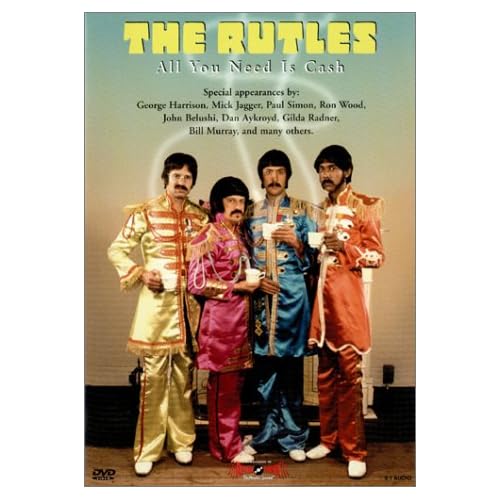
The best band to every parody the Beatles (and the only one to receive the participatory help of one its members), the Rutles made a splash back in 1976-1978 with their take on John, Paul, George and Ringo.
First, it was as an Eric Idle skit prepared for "Saturday Night Live" in October, 1976. Then, buoyed by the audience response to the film, SNL producer Lorne Michaels got behind a full-length mockumentary of the band, which made its NBC debut in 1978. Never mind that it finished at the bottom of the ratings. The film is a comedic masterpiece. And it is the only film you'll ever find that has members of Monty Python (Idle, Michael Palin) sharing screen time with SNL's Not Ready for Prime Time Players (Gilda Radner, Dan Aykroyd, Bill Murray and even John Belushi).
Oh and, in the clip below, see if you recognize the guy with the gray hair interviewing Palin and Rolling Stone Ron Wood (playing a motorcycle gang member).
That's right. That is indeed George, a longtime friend of Idle and the rest of the Pythons who helped produce many of their films. According to scuttlebutt on the web, Harrison wasn't the only former Beatle to appreciate the movie. Though the Yoko Ono stand-in is portrayed as a Nazi in the movie, John is said to have loved the film so much that he refused to send back the advance copy he was sent. Ringo is also said to have been pleased, though some of the sadder parts about the "break up" were said to have hit too close to home. And Paul, initially unhappy about the whole thing, is said to have come around after he met Idle and learned they both grew up around the same area.
But that's not the point of the post. Earlier this week, the great Popdose blog talked about the Rutles "reunion" album Archaelogy (1996), the group's response to the Beatles' Anthology (1995) documentary. Today, I want to focus on the music recorded for the original film, which is still in print, thankfully.
The actual musical group the Rutles consisted of three of the four band's members from the film: Neil Innes, Ricky Fataar and John Halsey. All of Idle's singing parts (and additional instrumentation) were provided by Ollie Halsall, who died in 1991 but appears briefly in the film as "Leppo," the fifth Beatle.
If you are a Python fan, you might remember Innes as the minstrel who sung "Brave Sir Robin" in Monty Python and the Holy Grail (1975). A former member of the Bonzo Dog Band, which appeared in the Beatles' Magical Mystery Tour (1967), Innes was the musical maestro of the project and wrote most of the spot-on songs – too spot on , in some cases. Lennon reportedly warned Innes that "Get up And Go" was so similar to "Get Back" that he might get sued.
As for Fataar, who doesn't speak a word in the film, he was briefly a member of the Beach Boys as you might remember from this post.
Directed by Gary Weis, who was the auteur behind many of SNL's short films in the early days, All You Need Is Cash is a really funny film that pre-dates This is Spinal Tap (1984) in making fun of the conventions of musical documentaries. As with most Python skits, it gets pretty silly at times, but there is also a good deal of sophisticated wit. The best SNL cameo comes from Belushi, who – flanked by his bodyguards Al Franken and Tom Davis – plays the Beatles manager Ron Decline (a play on Allen Klein)
My favorite part of the movie, though, is a scene where none of the Rutles appear on screen – at least not in human form. It's an animated spoof of Yellow Submarine (1968), which includes Innes' best song for the film, "Cheese and Onions." Reportedly, the song was once mistaken for a Beatles outtake.
Back to that Rutles reunion. I won't go into too many details because there is an excellent recounting of the events that I suggest you read at the blog WhatGoesOn.com both here and here. Innes and Idle, reportedly at odds for years, resolved their differences and reunited for a 30th anniversary screening of the film in Hollywood on St. Patrick's Day.
When it comes to soundtracks, I'm constantly surprised about what is still in print and easily available.
As long as the film remains popular, the music from it will be perennially available, no matter how dated it might be. After all, what would all those aerobics classes do without being able to buy a new copy of the Flashdance (1983) soundtrack?
There are exceptions, of course.
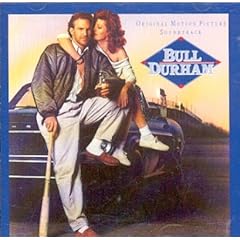
You'd be hard pressed to find a more popular baseball movie than Bull Durham (1988). So many of its best lines continue to be part of the American cultural vernacular. And it's one of the few baseball films that appeals almost equally to men and women
The soundtrack from it is pretty damn good as well, mixing previously released classics from John Fogerty ("Centerfield"), The Blasters ("So Long Baby Goodbye"), George Thorogood ("Bad to the Bone") and Los Lobos ("I Got Loaded") with some original Bennie Wallace/Dr. John collaborations.
The damn CD is out of print. Look it up on Amazon and you'll find used copies selling for no less than $60.
Weird.
Fortunately, I have the vinyl version of the soundtrack. And today I'll include some of my first vinyl rips. Just be forewarned: Until I get the hang of this thing, their quality could be a little dicey.
Earlier this week, I dissed Belinda Carlisle while also highlighting the work of Jane Weidlin. Just to continue to show that I have nothing against the Go-Go's (just their Reagan-loving lead singer), I'll go with "Middle of Nowhere" by House of Schock, a great pop song sung by Go-Go's drummer Gina Schock for the band's first and only album that somehow wound up on this soundtrack.
Next, we'll go with one of the three Bennie Wallace/Dr. John collaborations on the album. Wallace, for those who don't know, is an accomplished hard-bop saxophonist then signed with Blue Note Records, but doing film music during that period for extra money. It's always fun to hear jazz saxophonists jam with rock and pop musicians. This outing is no exception with three solid songs that close the album: "Try a Little Tenderness," "All Night Dance" (with Stevie Ray Vaughan doing the guitar solo) and "Love Ain't No Triple Play." We'll go with the latter, as it is baseball-themed and features the good doctor duetting with Ms. Raitt. (It also is the one song that is difficult to find anywhere else: The Vaughn collaboration is featured on the 1985 Blue Note album, Twilight Time.)
By the way, there's an extra bonus for Southern rock fans: The heart of Little Feat's rhythm section, Kenny Gradney and Ritchie Hayward, provide the backing for this track.
There's probably a back story about why this soundtrack is out of print – one that has little to do with the quality of the music or the dmand for the music. Maybe someone out there can enlighten us.
In the mean time, I think I'll continue to scratch my head …
A few weeks ago, I bemoaned soundtracks that didn't include songs that were prominently featured in the movie.
In the case of White Nights (1985), thank goodness for that shortcoming.
The big hit from the movie (and winner of the Academy Award for Best Song) was "Say You Say Me." It's not only a Lionel Richie track, but it's a really awful Lionel Richie track with some of the worst lyrics to hit the airwaves since my "My Ding a Ling."
All together now: "Say you, say me/Say it together/Naturally/I had a dream/I had an awesome dream"
According to Wikipedia, Motown didn't want Richie's first recorded output since Can't Slow Down (1983) to appear on another label. So Atlantic Records lost out.
Like I said: Thank goodness.
The soundtrack to the Mikhail Baryshnikov and Gregory Hines vehicle did enter the top 20, thanks to an almost equally big hit: The Phil Collins/Marilyn Martin duet of "Separate Lives," a song that Stephen Bishop ("On and On," "It Might Be You") wrote about his break-up with actress Karen Allen.
One of my early Soundtrack Sunday posts focused on an infinitely superior Martin song. So I'll leave this one alone. Instead, I'll focus on all the goodies that were included on this typically eclectic collection.
Director Taylor Hackford (The Idolmaker, Ray, La Bamba and An Officer and a Gentlemen) sure knows how to pick songs that introduce mainstream audiences to unfairly neglected artists. Such is the case here, where we have the likes of David Pack (Ambrosia), Robert Plant, Nile Rodgers and David Foster mixing with Lou Reed and John Hiatt.
The big twist is that Hiatt and Reed somehow put together danceable songs that don't stray too far from their strengths as artists.
Hiatt's "Snakecharmer" is all snarly in a a way that only America's answer to Elvis Costello can pull off. Amid all the programmed beats on many of the other songs included on this collection, it's great to hear Hiatt staying with his organic sound while adding a few power chords that punctuate the proceedings.
"My Love is Chemical" by Lou Reed is a different animal altogether. Musically, it's a product of its time with the floating synths, programmed rhythms, vocoders (!) and slick 80s feel. But Lou Reed is Lou Reed. And this ain't no "Flashdance." I loved this slinky song about 20 years ago. Although time has eroded my fondness for it, I still get a kick out of listening to this tune and thinking it was part of the American mainstream at one time.
As for the movie itself, it also was a product of its time. Just in the same way Hollywood is feeding the American people's own paranoia with post-9/11 New York destruction movies like Cloverfield (2008), I Am Legend (2007) and The Day After Tomorrow (2004), the Reagan-era 80s saw filmmaker come out with movies like Red Dawn (1984), The Day After (1983) and White Knights (1985) pontificating about how the evil Soviet Empire wanted to be in our living rooms one day. The movie, about a Soviet defector suddenly once again trapped behind the Iron Curtain, certainly had its share of exciting moments. But the unreal political message undermines its effectiveness – at least today. The fearsome Soviet bear, as we all know by now, was nothing more than a paper tiger.
Like a lot of you, I was pretty disappointed by last month's Academy Awards.
The biggest thing that bothered me? Not the gowns. Nor the idiotic patter on stage. No, it was the nominated songs from Disney's Enchanted (2007) that could only be described as craptacular.
What a letdown.
In the 90s, while the rest of you were probably reveling in Radiohead and Wilco, I was being subjected to the musical tastes of my sons, who have just turned 11 and 15. So during long road trips, that meant a lot of Barney, "Chicka Chicka Boom Boom" and the soundtrack to whatever Disney movie had caught their fancy at the moment.
Fortunately, this was during the heyday of Alan Menken, Howard Ashman, Tim Rice and several other top composers employed by Disney. Of all this prodigious output, my favorite had to be Hercules (1997), which combined the talents of Menken and David Zippel (Broadway's City of Angels).
Certainly, the movie was not to everyone's taste. Because the original Greek myth contained sex, gore and all kinds of anti-Disney things, the filmmakers turned the story on its head. Basically, it was a series of running jokes strung together with piles of anachronisms. Everything else was also different from the Disney animated blockbusters of the previous few years: From the design of the characters (by Pink Floyd favorite Gerald Scarfe) to the songs themselves, which eschewed Broadway conventions for numbers infused with a melange of Motown, gospel and old-time R&B.
The one exception was the worst song – and, of course, the film's big hit: "Go the Distance" sung by future Producers (2001) star Roger Bart in the film and Michael Bolton (groan) during the credits.
I'm staying away from that one.
Instead, I want to focus on this little gem, sung by the actress who voiced Hercules' love interest, Megara. Relatively unknown at the time, Susan Egan would go on to originate Belle in Beauty and the Beast on Broadway. For me, she will always be known for this song, which has become one of the guilty pleasures on my iPod. I love the call and response with the Greek chorus, but I also think Egan really knows how to belt this song.
Here's a video of Egan performing the song live (or maybe "plausibly live") a few years ago in New York City.
Interestingly enough, in some non-U.S. versions of the film's soundtrack, there was a second rendition of the song by Belinda Carlisle. It ain't bad, but I think it just further demonstrates how Egan was able to make the song her own.
By the way, the 15-year-old is now mastering Killers songs on his electric guitar. And the 11-year-old requested the latest My Chemical Romance album for Christmas.
Usually, this is the day when I pull some long-forgotten soundtrack out of obscurity.
Or offer a new look at some film music that might have gone unappreciated at the time of its release.
Neither is the case here, of course.
Any hipster probably already has a copy of this excellent collection, which won a Grammy in 2005 for Best Compilation Soundtrack, landed on several critics' "best of" lists that year and was certified gold by the RIAA. Aping the work habits of Cameron Crowe and John Hughes, writer, star and director Zach Braff used music that he was listening to while writing the movie. He considered it as a kind of mix tape for the movie, rather than a soundtrack.
Here's why I want to talk about this album today: Because it is a perfect antidote to one of my pet peeves about movies and the soundtracks that come out of them.
How often do you come out of the movie, obsessing about all the cool songs in the film and vowing to go out and buy the soundtrack? Then when you go to the store, half of them aren't on the CD. I remember loving the main theme to one of my favorite films of all time, The Year of Living Dangerously (1982) and then not finding it on the soundtrack. For some strange reason, director Peter Weir hired Maurice Jarre to do the score – and then used Vangelis' "L'Enfant" as the main theme, which was only available on his Opera Sauvage (1979) album.
Or maybe it's just the opposite. The songs on the soundtrack almost have no relation to the movie. Maybe they were heard for a few seconds on the radio during a scene or they were (shudder) "inspired by" the movie. This seem to be a particular problem during the 80s where selling a hit-filled soundtrack seemed to be as important as getting people into the movie theater. Even Crowe and Hughes have been guilty of this at times. Admit it: Do you listen to the Pretty in Pink (1986) soundtrack and think about Molly Ringwald getting ready for her big date with Andrew McCarthy?
Probably not.
Which, happily, brings me back to Garden State. Reportedly, the movie's release was delayed so that Braff could get approval for all the songs he wanted in both the film and on the soundtrack. It was well worth the wait. Not only is the music excellent, but it just about defines the movie. Each song I hear evokes specific scenes because none of them are ever used perfunctorily. According to IMDB, an extraordinary 13 of 18 songs played in the movie are on the soundtrack CD. (One of those excluded was "Three Times a Lady," thank you very much). Truthfully, other than Alexi Murdoch's "Orange Sky" (which the producers couldn't secure for the album), I can't think of one song I remember from the movie missing from the soundtrack.
Braff's song selection is also quite excellent, making all kinds of cross-generational connections that even the best soundtracks fail to do. For the younger 20-somethings, this was probably the first time they heard a song from Simon and Garfunkel (The underrated "The Only Living Boy in New York") that wasn't on their parents' greatest hits collection, which they probably got sick of by the time they turned 12. You can also never go wrong with teaching unwashed hipsters about Nick Drake ("One Of These Things First") And it's great that Mr. "Down Under" Colin Hay was able to regain some well-deserved respect with the entirely acoustic "I Just Don't Think I'll Ever Get Over You."
As for the older folks who had never heard of bands such as The Shins, the Cary Brothers or Remy Zero, this was a great way for them to start opening their ears to the 21st century. I know that I didn't start taking trip-hop seriously until I got totally entranced by the cuts from Frou Frou ("Let Go"), Thievery Corporation ("Lebanese Blonde") and Zero 7 ("In the Waiting Line"). Play "Lebanese Blonde" by Thievery Corporation
So there you have it. Yes, I didn't throw the spotlight on anything you hadn't heard before. But hopefully I've given you something to think about – and maybe even the powers-that-be in Hollywood who need to learn a little bit more about how soundtracks should be.
Robbie Robertson loved Mean Streets (1973) so much that he asked the movie's director to film what would be The Band's final concert.
Thus was the beginning of The Last Waltz (1978), possible the greatest rock concert movie ever made. And thus was the beginning of a long and fruitful relationship between The Band's guitarist and chief songwriter and the film's director, Martin Scorsese.
The two were such good buddies that they actually lived together for a time. And indulged in the same – ahem – recreational substances.
With his career as a member of The Band now over, Robertson was ready to try new things. And thankfully, his friend was there to supply him with new challenges.
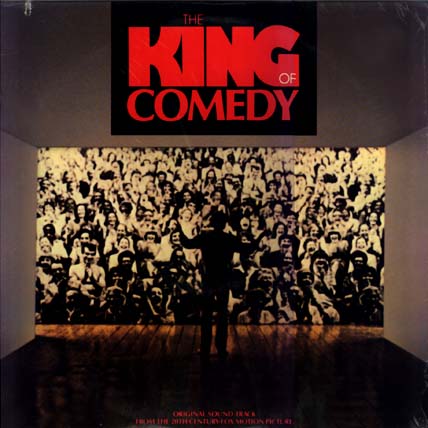
First, Scorsese asked Robertson to score Raging Bull (1980). Then came the next project, King of Comedy (1983), a film about an obsessed fan's scheme to become as famous as the TV star he idolized. And it would be a little bit different than the straightforward release of incidental music as the soundtrack.
Compilation soundtracks were just starting to get into vogue. And besides composing instrumental music for the movie, Robertson had to stuff the film's accompanying album with tracks from established artists.
For a strange movie with a cast that included Robert DeNiro, Jerry Lewis and Tony Randall (!), – not to mention Sandra Bernhard in her first and possibly most bizarre role – the soundtrack is almost equally strange.
Check out this cast of contributors: Ric Ocasek. Rickie Lee Jones. Bob James. The Pretenders. The Talking Heads. Ray Charles. David Sanborn.
OK, so a lot of these songs were not especially made for the movie but were castoffs, previously unreleased or just not released yet. (An example of the last category: "Back on the Chain Gang" gave the Pretenders their highest charting U.S. single to date by reaching No. 5, nearly six months before it would be released on the Learning to Crawl (1984) LP).
Several of the best tracks, however, were the result of Robertson's hard work.
Robertson produced B.B. King's take on the standard "T'aint Nobody's Bizness (If I Do)," which remains my personal favorite song from the venerable blues guitarist. King was never a classic blues man like Muddy Waters. He has always been at his best when he's belting out songs in a big band setting, which is what we have here.
As I always seem to do on these Sundays, I'm saving the best for last.
You can have your "Moondance," your "Domino," your "Jackie Wilson Said," your "Tupelo Honey." In my book at least, Van Morrison may not have recorded a better song than "Wonderful Remark," which closes both the album and the film.
Robertson not only produced the song, but provides some amazing lead guitar. And then as an added bonus, there's some outstanding organ playing from the incomparable Nicky Hopkins. Morrison's voice goes with the flow of the slowly-building song. He whispers, he croons, he even yelps. Even filmgoers who hated the movie (which was somewhat of a bomb, but it has gained in stature over the years) were probably leaving the theater humming.
One more note about the soundtrack: The song "Between Trains" marks Robertson's debut as a solo artist. Written as a tribute to a Scorsese assistant who had died suddenly during filming, the song featured ex-Band mates Garth Hudson on synthesizer and Richard Manuel on backing vocals.
For rising bands that can do no wrong, nothing can quite stop momentum in its tracks like a vanity project.
Witness the Beatles Magical Mystery Tour (1967), the first "film" that the Fab Four wrote and directed themselves. It was pretty bad (though amazingly prescient compared to the music videos that would emerge 15 years later). Somewhat unfairly, critics took its shortcomings as a cue to unleash all their pent-up hostility about the band that previously could do no wrong. It was condemned and mocked in the press, and certainly did nothing to prevent the band from eventually drifting into their eventual breakup.
I have no idea what Idlewild will do to OutKast's career (word is the duo will release at least one more album), but there's no doubt that the film was perhaps the first misstep in what had been a pretty charmed career.
Only the second rap/hip hop artists to win the Grammy for album of the year in 2005, Andre 3000 and Big Boi were definitely riding high when they started filming Idlewild with their longtime video director Bryan Barber at the helm and an impressive cast that included Terrence Howard, Cicely Tyson, Ben Vereen and Ving Rhames – not to mention fellow musicians Macy Gray and Patti LaBelle. The New York Times Magazine even did a lengthy piece on Andre and Big Boi to promote the project, an almost unheard of sign of respect from the old gray lady.
Released in August 2006, however, the film disappeared in a matter of weeks. Most of the critics savaged the film, with it getting a rating of 47 percent rotten from RottenTomatoes.com. Produced on a $15 million budget, it only managed to earn $12 million at the box office. On top of that, there was controversy about the location of Idlewild in the film – Georgia according to Outkast, Michigan according to the real Idlewild where well-to-do blacks spent their leisure time at the turn of the century.
Did the film deserve such a beating? Probably not. Forget about the plot for a moment, with its cliches of a doomed romance, double-dealers and an underdog's rise to the top of the local bootlegging operation. This was an extremely stylish piece of work with the kinds of visual inventiveness not seen in a musical movie since Purple Rain (1984) – a vanity project that fared much better. The early 20th century feel of the movie felt just right and the dance sequences – choreographed by three-time Tony winner Hinton Battle – are pretty amazing.
Then there's the music. Sure, there are standard Outkast songs on the soundtracks. But to my ears, they were greatly outnumbered by valiant attempts by the duo to fit in with the period. Andre 3000, as eclectic as ever, even manages a credible simulation of an early 20s Broadway musical number with "When I Look In Your Eyes," which closes the movie. And then there's his dirtwater stomp, "Idlewild Blue (Don'tchu Worry About Me)," which places a Delta blues guitar in the middle of the proceedings.
I also love the creativity of the first single "Morris Brown," in which Big Boi uses the marching band from the historically black Atlanta college of the same name to provide the backing for his rap.
But Big Boi's best work comes on "The Train," where you truly see how this impressive artist absorbs everything he listens to and uses it in is work. You have sitars, Philly Soul brass, audio clips from the movie, a loping hip-hop track and some killer hooks combining into one great song. Why this wasn't a crossover hit in the way that "Hey Ya" and "The Way You Move" were eludes me to this day. Play "The Train (featuring Sleepy Brown & Scar)"
In any case, this film is a solid rental that I highly recommend. And it has a soundtrack that I probably will be listening to for several years to come. Which is a high achievement for any soundtrack, let alone one from OutKast.
Today, I'll focus on a soundtrack that features one of the best songs from one of the most well-known acts he produced.
Believe it or not, it's from a Chevy Chase film.
That film would be Fletch (1985), either one of the decade's comedic masterpieces or a cosmic affront to the literary detective created by Gregory McDonald – depending on which person you talk to on any given day.
Released on MCA records, the album was an attempt to repeat the label's multi-million dollar success with Beverly Hills Cop the previous year. And in several blatant ways too.
For example, most brazenly, you have Mr. "Axel F." Harold Faltermeyer producing the score. If he didn't compose it himself, Faltermeyer could have sued himself for plagiarism for both "Exotic Skates" and the "Fletch Theme." Bum-bum-be-bum, indeed.
Other repeats: Dan Hartman attempt a Glenn Frey impression with "Fletch, Get Outta Town." And Stephanie Mills – trying to keep up with the other 80s divas with crossover hits – channels Patti LaBelle (or the Pointer Sisters, take your pick) with the Faltermeyer co-composition "Bit by Bit (Theme from Fletch)" I've developed a certain fondness for this song because it has some nice hooks, so I'll put it here.
The rest of the soundtrack is made up of leftovers from MCA artists such as Kim Wilde ("Is It Over"), John Farnham ("Running for Love") and The Fixx.
Their song "Letter to Both Sides" pretty much redeems the band in my eyes. It's got great swirling guitars, a killer chorus and a propulsive beat. And vocalist Cy Curnin, who annoyed me throughout the 80s to no end, does some of his best work. I have since grown to appreciate The Fixx more – they were, for example, more lyrically sophisticated than their techno-pop contemporaries – and perhaps this song has helped out in that respect. Play "Letter To Both Sides" by The Fixx
There was a sequel called Fletch Lives (1989). And In the last 20 years or so, there have been plans to produce a third film based on McDonald's prequel book Fletch Won. But right now, it appears to be in development hell. Kevin Smith wanted to do it with Jason Lee in the title role. Scrubs creator Bill Lawrence wanted to pair up with Zach Braff. No go on all counts. Last I heard, Joshua Jackson (Dawson's Creek) and director Steve Pink (Accepted) were the major names affiliated with the project.
In between releasing Love Over Gold (1982) and the best-selling Brothers in Arms (1985), Dire Straits leader Mark Knopfler found ways to keep himself busy without his band.
Sort of.
Because Knopfler's first soundtrack – and still the most beloved in many circles – is essentially a Dire Straits album. One track, "Freeway Flyer," includes the entire band except for drummer Pick Withers. And keyboardist Alan Clark actually plays on more tracks than Knopfler.
I love the movie (I'll get into that later). And I love the soundtrack. It was an essential study aid during my college years. It's a relaxing mix. But not so relaxing that it makes you stupid, like so much of what was being defined as New Age music back then.
For today's post, I want to focus on two tracks from the soundtrack. Which is, by the way, not billed as a soundtrack. It's called "Local Hero: Music by Mark Knopfler" But that's a misnomer. This is no "Music Inspired by…" (Yes, I'm looking at you, Jay Z) album. All the songs are featured in the movie and are essential in terms of establishing the film's overall mood.
The first track is the only one on the album to feature vocals: "The Way It Always Starts." And it's not Knopfler who sings, but Gerry Rafferty. Yes, the same guy from "Baker Street" and "Stuck in the Middle." It's a beautiful song that benefits from Rafferty's mellifluous voice perfectly blending with Knopfler's crisp guitar playing and Clark's airy keyboards. If this was released in the mellow 70s, this would have been a No. 1 hit. for sure.
But that was not Warner Brothers choice as the album's (only) single. The peculiar selection instead was the movie's theme song, "Going Home: Theme of the Local Hero", which is also a very solid tune and one that Knopfler still plays at concerts. But the song lasts nearly five minutes – and the first half of it consists of Knopfler and Clark aimlessly trading riffs. I mean, did Warner Brothers think this was when the DJ was supposed to give the weather and traffic reports? When the song finally kicks in, it's the late Michael Brecker who puts the song into high gear with a killer sax solo. Oh, and by the way the great Tony Levin (ex of King Crimson) plays bass. Play "Going Home: Theme of the Local Hero"
Back to the movie: If you haven't ever seen it, I highly recommend it. It still remains one of my top five favorite movies. I mean, what other movie has guys from Animal House and Star Wars cavorting with Burt Lancaster on the Scottish moors? The story is about the owner of a Texas oil company (Lancaster) who sends one of his executives (Peter Riegert, Boon from Animal House) to Scotland to buy up a town where he wants to build an oil platform. The tiny town's defacto leader, a local innkeeper named Gordon Urquhart (Denis Lawson, Wedge Antilles from Star Wars) is only too eager to comply. Then the movie really takes off in unpredictable ways until the unforgettable ending.
For this week's Soundtrack Sunday, we're going to shake it up a little bit.
Hey, it's my blog. I can do what I want. And if I want to focus on two films – and two soundtracks – that's what I will do.
So what if one was one of the most staggering failures of the 1970s? And so what if the other has been hailed by The New York Times, among other publications, as one of the best films of 2007?
Separated by 29 years in terms of time, and a few million more in terms of quality, we will talk today about two films built entirely around Beatles songs – with nary a John, George, Paul and Ringo in sight.
And yes, we will compare and contrast. Which means we will focus on why one film failed so abominably and the other stands as one of the most visually audacious films of recent years (Do I sound like a film critic yet?)
Yet they do share some things in common – beyond the nine songs that are featured in both films.
Each, in its own way, was a product of its time. As in the marketing forces in play.
For Sgt. Pepper…, this was Robert Stigwood's attempt to hit another one out of the ballpark, less than a year after Saturday Night Fever returned the movie musical to the forefront. In fact, less than a month earlier, Stigwood's Grease became a box-office bonanza.
But this movie was just all wrong. In a sense, Stigwood was trying to recreate the magic of his own Tommy (1975) with Lennon and McCartney subbing for Pete Townshend; and Peter Frampton stepping in for Roger Daltrey. Rock stars. Rock music. A story that didn't make too much sense. What could go wrong?
A lot. Because though it's camp value is treasured by some, this movie is mess. Frampton and the Bee Gees just can't act. Steve Martin may never live down the fact that he made his movie debut as "wacky" Dr. Maxwell Edison. George Burns, who plays the mayor of Peppertown, had to supply narration because everyone was afraid no one would understand either Frampton or the Gibbs brothers because of their non-American accents. You listen to almost every song and you want to turn on the mute button because it destroys how much you liked it. (Unfortunately as a middle schooler who had not yet experienced the wonders of the 1967-69 Beatles, it represented my first exposure to several of these classic songs. Damn you, Hollywood!)
Everything is completely laughable.
Except for the fact that there were two cool songs in the movie: "Come Together" by Aerosmith (which, during the band's drugged out phase, played the film's villains, the Future Villains Band) and "Got to Get You Into My Life" by Earth Wind & Fire.
I'm posting the YouTube clips so you can get a small sense of how bad the movie is. But also appreciate the rays of light these bands let in during this awful mess.
I'm also posting the mp3 of the "Got To Get You Into My Life" which McCartney wrote for the Revolver album as a semi-Motown song. It's nice to see Earth Wind & Fire's Maurice White (a professed Beatle fan) do a little role reversal and perhaps even improve upon a song written by a rock artist. Play "Got to Get You Into My Life" by Earth Wind & Fire
Luckily, "Come Together" allows us to segue into Across The Universe because it appears in both movies. And, in my mind, it is the biggest highlight of a film filled by lots of highlights. Because out of nowhere, one of the greatest interpreters of Beatles songs, Joe Cocker, begins serenading one of the film's main characters. And not only that, he plays three roles in the course of the song, which develops slowly into a full-blown production number full of the "accidental" urban choreography that has become one of Taymor's trademarks. Play "Come Together" by Joe Cocker
Like "Sgt Pepper," this is another project that is a product of its time. The critical and commercial success of film musicals such as Chicago, Dreamgirls and Moulin Rouge have prompted studios to OK audacious projects such as this one. It has also given semi-free reins to innovative spirits such as Taymor, who made her first big splash by directing The Lion King on Broadway and went on to helm Frida (2002).
Thanks to Taymor, this film is never boring. And she makes plenty of unexpected choices along the way that keeps the film hopping. For example, "I Want You So Bad" is sung by an animated Uncle Sam getting a new army recruit. Or "Strawberry Fields Forever" gets performed as the movie's protagonist, Jude, pins the fruit onto canvas as a kind of performance art. I also like how she successfully mixes early Beatles songs – "Hold Me Tight," "If I Fell," to name a couple – with later ones.
The script about a bunch of young adults experiencing all the highs and lows of America during the 60s also seems to work in ways that Sgt. Pepper … doesn't. But then again, that's not entirely unexpected given that Dick Clement and Ian La Frenais wrote another great rock film: The Commitments (1991)
I also thought the cameos were surprisingly effective – chief among them a semi-disguised Bono, as the Ken Kesey stand-in Dr. Robert, who sings a rather credible "I Am The Walrus" at an acid-tinged psychedelic party.
Here's the clip:
Not everything works in the movie. I am not convinced that the closeted lesbian, Prudence (yes, almost all the characters are named after Beatles songs), was necessary to the plot. And the water ballet scenes are a little too precious.
But I heartily recommend that you rent or buy it when it comes out on DVD next month. You won't be disappointed.
Or bored.
Since this was a post about two movies, I thought I'd end it with a fun little table I devised comparing both movies.
Movie
Across The Universe
SPLHCB
Number of songs
32
28
Number of albums represented
9
6
Most represented album
White Album (7 songs)
Sgt. Pepper's and Abbey Road (12 each)
Number of pre-1967 songs
7
2
Number of songs from Revolver
0
1
Most surprising musical cameos
Bono as Dr. Robert, Joe Cocker as Bum/Pimp/Hippie
Aerosmith as FVB, Alice Cooper as the Sun King
Cameos by comedians
Eddie Izzard as Mr. Kite
George Burns as Mr. Kite
Well-known actors
Dylan Baker, Salma Hayek
Donald Pleasance, Steve Martin
Best Performance
"Come Together" by Joe Cocker
"Got to Get You Into My Life" by Earth Wind and Fire
Director
Julie Taymor
Michael Schultz
Resumé
"Frida," "Titus" and Broadway's "Lion King"
"Car Wash," "Disorderlies" and "Krush Groove"
Credibility claims
Both surviving Beatles reportedly liked the movie
Billy Preston performed "Get Back"; George Martin produced the soundtrack
Here's an ironic twist: One of the defining soundtracks of the 80s was, as a film, a miserable failure at the box office.
Walter Hill's Streets of Fire (1984) cost about $14 million to make and collected less than $10 million in ticket sales. Billed as "a Rock & Roll Fable," the film starred a pre-Eddie & The Cruisers Michael Pare, Willem Dafoe, Diane lane and Rick Moranis. Quite a combination. But even Hill, fresh off his success with 48 Hours, couldn't quite pull it off.
Anyway, the soundtrack has gained cult-like status – thanks to its top ten hit "I Can Dream About You" by the late Dan Hartman, which was performed in the film by a Temptations-like group that included Robert Townsend.
But you know what? I'm tired of that song. So I'm not going to feature it here.
And I'll also skip two other songs that made a popular dent: Fire Inc.'s "Nowhere Fast" and "Tonight Is What It Means To Be Young." Composed by Jim Steinman, in between Bat Out of Hell and "Total Eclipse of the Heart," they feature his usual Wagnerian bombast about love and other rock 'n' roll cliches. Sometimes, I really dig Jim's stuff. Not this time. The two songs are simply over the top.
Which leads us to two songs that make the soundtrack essential: "Sorcerer" by Marilyn Martin and "Countdown to Love" by Greg Phillinganes. Download "Sorcerer" by Marilyn Martin.
Penned by Stevie Nicks and performed by one of her back-up singers, this would be the greatest Stevie Nicks song that the Welsh Witch never performed – except she did eventually record her own more acoustically-oriented version on Trouble in Shangri-La (2001) nearly two decades later.
While I normally prefer a more stripped down sound, I love the production on this song. Someone might want to correct me, but I believe a few Heartbreakers, Ry Cooder and Roy Bittan of the E Street Band are providing some of the instrumental backing. Which really gives it the necessary heft to compete with Martin's strong vocal performance.
So many things to adore on this song: The opening piano chords. The pedal steel. The vocal acrobatics from Martin, who would go to greater soundtrack success a year later with Steven Bishop-penned "Separate Lives" for White Nights, a duet with Phil Collins.
The other song I really enjoy is from Phillinganes, a studio musician who (among other albums) can be heard playing keyboards on Michael Jackson's Thriller. In the mid-80s, Phillinganes launched a bit of a solo career, even having a modest hit with the solid song "Behind the Mask." As you can hear, he doesn't have the greatest voice. But it works on this fun little number, which I think stands out as one of the more unique contributions to 80s soundtracks. Download "Countdown to Love" by Greg Phillinganes
Thanks for reading and listening. And Stay tuned for next week's Soundtrack Sunday. I might even be tempted to enter the 21st Century (gasp!).
Somewhere in between playing Duckie in Pretty in Pink and reappearing on CBS as Charlie Sheen's foil in Two and a Half Men, Jon Cryer actually had a few starring vehicles that were supposed to turn him into a big star.
Well, it didn't work.
But we did get 1987's Hiding Out, the big-screen directing debut of MTV pioneer Bob Giraldi. The story was that Cryer was a stockbroker who decides to hide out from the mob by pretending to be a high school student.
But never mind all that.
Today's subject is the soundtrack, one of the early releases on Virgin's just-launched U.S. division. Given the label's deep pockets (and Giraldi's many connections after directing some of the decade's defining music videos, including "Beat It," "Love is A Battlefield" and "Running With the Night"), it's not surprising that it had many notable performances – including "Seattle by P.I.L., Boy George singing "Live My Life" and the top 40 hit "Catch Me I'm Falling" by Pretty Poison.
Here's the Giraldi-directed video for the last song, which also shows scenes from the (mostly forgettable) movie.
But none of those were the soundtrack's real highlight.
For me (and many others), the only reason to pay attention to this collection was a duet between Roy Orbison (a newly signed Virgin artist) and k.d. lang on "Crying"
Now, like you, I'm not normally a fan of forced duets. Especially ones that have the potential to ruin songs that should be respected as American cultural classics.
This is not one of them, I think you'd agree. (And so did Grammy Award voters, who named it Best Country Collaboration with Vocals in 1988)
This not only holds a candle to the 1961 original, but adds an extra dimension to it. Amid all the discussion of lang's appearance and her sexuality, few people recognize that she is an amazing singer. That her voice not only has spectacular range (something she needed to keep up with the inimitable Orbison) but has the emotional depth that so many of her peers lack.
This is a woman also blessed with the ability to sing just about anything. Don't believe me? Fifteen years later, she went on to record an album of Louis Armstrong tunes with Tony Bennett. Yeah, that's right.
Anyway, enjoy the song. And I'll be back with more soundtrack goodies from the vaults next Sunday.