Showing posts with label Stan Getz. Show all posts

Thursday, May 15, 2008

Unlikely Cover of the Week – Cybill Shepherd "This Masquerade"


Maybe you were perhaps expecting a song from the 80s or 90s when Shepherd was already a big star, thanks to "Moonlighting" and her self-titled sitcom "Cybill?" A time when she had the pull, just like her co-star and "pal" Bruce Willis, to play prima donna and demand that the music busiess make her a major singing star?

Nope, believe it or not, this cover of the Leon Russell song (first made popular by George Benson) comes from her 1976 release called Mad About The Boy. Shepherd was just 26 then, a former beauty queen who was five years removed from her head-turning debut in The Last Picture Show (1971). Even back then when she probably wasn't always called back by her own agent, she desired to be an an actress and a cabaret-style singer – and this album, recorded over four days in a Hollywood studio. represents her first attempt at making that transition.

Play "This Masquerade" by Cybill Shepherd

But that's not the best part of the album.

Listen to that saxophone. Your ears aren't deceiving you. That is indeed Stan Getz backing Ms. Cybill with his inimitable sound. If it sounds vaguely like Stan is is once again in the Bossa Nova frame of mind, there's good reason for that. This is his first album after his final recording with Joâo Gilberto, Best of Two Worlds (1976), which we covered in this earlier post. Furthermore, the great Brazilian guitarist Oscar Castro-Neves, who arranged the music on Best of Both Worlds, did the same duties for this album – having Shepherd cover Antonio Carlos Jobim's "Triste" for good measure.

Play "Triste" by Cybill Shepherd


As he was throughout this prolific mid-70s period when he was working with the likes of Chick Corea, Ron Carter, Jimmy Rowles and Bill Evans almost every month, Getz is once again in fine form. Give him credit. Shepherd is no great shakes as a vocalist (although she makes the most of her limitations). He could have phoned this performance in and simply lent Shepherd his name to sell the album or provide her with the credibility she craved. But Getz' professionalism wouldn't let that happen. As you can hear, there are some really nice Getz licks on this album. As a big fan of this genius saxophonist (isn't that apparent by now?), I'm glad this album is in my collection.

Tuesday, February 19, 2008

Two-Fer-Tuesday: Stan Getz, Boss of Bossa Nova


I feel bad about last week's Two-Fer-Tuesday: All those folks googling "Stan Getz" and instead of getting a few of his classic songs, they heard his renderings (admittedly noteworthy) of Billy Joel and Huey Lewis tunes.

So I'm trying to make amends by returning to "The Sound" and spotlighting his Bossa Nova output. The twist is that I'm not going to be focusing on all his 60's Verve albums that brought him widespread acclaim and popularity.

Instead, I want to concentrate on one of his sadly overlooked contributions to his Brazilian music catalogue.

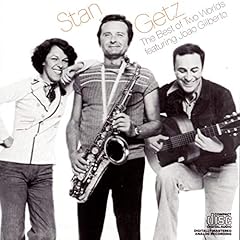
There are several reasons why The Best of Two Worlds (1975) never took off or was accepted as part of an amazing body of work that included Getz/Gilberto (1964), Jazz Samba (1962) and Stan Getz With Guest Artist Laurindo Almeida (1963). One was that though extraordinarily productive in terms of churning out albums during that era, Getz was involved in a nasty divorce. And he and João Gilberto weren't exactly the greatest of friends. Producer Joe Boyd, in his recent autobiography White Bicycles (2006) talks about Getz having an affair with Astrud Gilberto during the success of "The Girl from Ipanema," something that apparently was a factor in the pair's eventual divorce.

By the way, that's not Astrud leaning on Getz' shoulder on the album cover. That's Heloísa Maria Buarque de Hollanda, Gilberto's second wife. A Brazilian pop star in her own right known as Miucha, she is also the sister of the legendary Chico Buarque – and the mother of the bliss pop singer who would become Bebel Gilberto.

Back to the album, however. Though some feel that with all the turmoil in his life, Getz' playing is just not up to par compared to the Verve Bossa Nova albums, I beg to disagree. To my ears, "The Sound" has not deteriorated at all. His sax playing, sensuous and full-bodied, is just right for the material.

And what material it is. Which is the second and most important to love this album. Because it is the only place to hear Getz and Gilberto combine on two of my favorite Antonio Carlos Jobim songs: "Aguas de Março (Waters of March)" and "Double Rainbow."

In a 2001 poll of 200 Brazilian music journalists, "Aguas de Março" was voted the most beautiful Brazilian song of all time – perhaps not just for the 1972 composition's melodic twists and turns, but for the exquisite poetry of its lyrics. In a change for him, Jobim wrote both the English and Portuguese lyrics which focus on presenting images rather than telling a story.

Play "Aguas de Março" by Stan Getz and João Gilberto


"Double Rainbow" (Known in Portuguese as "Chovendo Na Roseira," which translates to "Raining in the Garden") was originally titled "Children's Games" when Jobim recorded it himself as an instrumental in 1971. Jobim renamed it when Jobim added lyrics (Gene Lees was the English lyricist this time). This is another gorgeous song that shows why Jobim rightfully can be called the Gershwin of Brazil.

Play "Double Rainbow" by Stan Getz and João Gilberto

There are a few other reasons to love this collection: A jaunty version of "Just One of These Things;" Gilberto's solo take on the heartbreaking "É Preciso Perdoar;" and the point-counterpoint of "Izaura," which showcases Miucha and Gilberto harmonizing.

To be sure, Miucha is not as sensual singer as Astrud. And she has gotten criticized for sounding too American on this album. But really, her performances suit the top-notch material contained on this CD. Do yourself a favor and add it to your CD collection or iPod. You won't be sorry.

As a bonus (and because I just adore this song), I've placed a YouTube video of Jobim's 1974 performance with Brazil's equivalent of Billie Holiday, the tragic Elis Regina. Despite Regina's laughing at the end, it is considered by many to be the definitive version of the song.

Tuesday, February 12, 2008

Two-Fer-Tuesday: Stan Getz, pop star?


As you probably know by now, Herbie Hancock's latest album River: The Joni Letters (the subject of last week's Two-Fer-Tuesday) broke a way-too-long losing streak at the Grammy's by winning Album of the Year Sunday night.

The last time a jazz album captured the biggest award in the music industry? In 1964, when Getz/Gilberto managed not only to win the Grammy but actually displaced the Beatles from the top of the Billboard charts.

It might be stating the obvious, but this is a wonderful album, full of classic tunes such as "Corcovado," "Desafinado" and (of course) "The Girl from Ipanema." I'm not embarrassed to say that my whole obsession with Brazilian culture started with this album. It's why I took Intensive Portuguese during my senior year at Georgetown and later developed a fascination for some of the most important figures in Bossa Nova and MPB: Tom Jobim, Caetano Veloso, Elis Regina and Chico Buarque.

At some point, I might devote a post to why this album is so essential and why Stan the Man was the perfect person to bring Brazilian music to the masses. But not today.

Today, I'm going to talk about Stan Getz, the 80s pop star.

Thankfully, we're not talking about heavy eye makeup, mullets and fingerless gloves. But towards the end of his life, Getz and his exquisite tenor saxophone playing found themselves in a few unlikely places.

The first was the debut album of blind vocalist Diane Schuur, whom Getz was instrumental in discovering and bringing to the attention of GRP Records after watching her sing "Amazing Grace" at the 1979 Monterrey Jazz Festival. Though Schuur would later become more of a classic jazz singer, recording with the likes of the Count Basie Orchestra, her 1985 debut Deedles attempted to cast her as a multi-genre vocalist – sometimes to embarrassing levels, as with “Can’t Stop a Woman in Love,” which sounds like a Flashdance outtake with all its synthesizers and programmed drums. As a whole, the release also suffers from the era's sterile production values, which were developed to showcase the cleanness of the still-new CD format.

Then there is "New York State of Mind," which showcases Schuur's ability to make pop standards her own. But that's not all. At the 2:45 mark, Getz kicks in with a majestic solo. Even people who are bigger fans of the Billy Joel original might wonder: How much more spectacular would it have been if Getz was the one playing the solo on Joel's Turnstiles (1976) album instead of Richie Cannata? Oh well.

Play "New York State of Mind" by Diane Schuur (featuring Stan Getz)


A few years later, Getz had reestablished himself in the San Francisco area as a result of a teaching position at Stanford University. And he was asked by Huey Lewis to play on his 1988 record Small World. To Lewis' credit, Getz didn't just get a perfunctory few notes to blow on his horn. Instead, the almost entirely instrumental "Small World (Part Two)" was built around Getz, who rises to the occasion and overcomes the fair to middling material.

Play "Small World (Part Two)" by Huey Lewis and the News (featuring Stan Getz)

There was almost something even bigger. One of the biggest pop stars in the world at the time, George Michael, reportedly got in touch with Getz because he wanted him to play on his next record. To bring this post around full circle, Michael was a professed big fan of Getz/Gilberto – so much so that he insisted on playing the entire album for Rolling Stone journalist Steve Pond during a 1988 interview. The pairing never came off, either because of poor timing, Getz's reluctance or his health problems. (Getz would die of liver cancer in 1991). Later, Michael would partially get his wish – duetting with Astrud Gilberto on a surprisingly credible "Desafinado" for the Red Hot + Rio (1996) benefit album

Just for this week, I will make this a three-fer. That's because I feel bad about giving Getz the short shrift in terms of his massive contributions to jazz. Here's a version of "The Peacocks" featuring Getz playing with Bill Evans. Getz played on the original version of this lovely jazz classic with composer Jimmy Rowles, but this 1974 cut from the live album But Beautiful certainly does the trick as well.

Play "The Peacocks" by Stan Getz and Bill Evans