I'm a professional writer and frustrated DJ who hasn't yet figured out how to use all his useless knowledge of music and pop culture for the betterment of mankind. Further questions? You can email me at playitandbedamned@gmail.com. and I promise I won't become too enraged.
All songs are for sampling purposesonly and are available online for a limited time. If the album is in print, go out and buy it and support the wonderful artists who have all made our lives a little better.
If you're the artist or copyright holder, a quick e-mail is all that is needed to remove the mp3.
Do not email me requesting the reposting of dead links or asking for a songyou cannot otherwise find. It's just rude.
Do not hotlink to the files on this site. Again, it's all matter of Internet manners
After all, I spent way too much time talking about Vienna Teng's extraordinary and intimate performance at the University of Michigan's Erb Student Space last month. That show was truly a once-in-a-lifetime experience.
That said, I really enjoyed this singer/songwriter's performance at Ann Arbor's Water Hill Music Fest this afternoon.
One day after she graduated with a dual degree from U-M's business and natural resources schools, Teng participated in one of the most unusual musical events in Tree Town – if not the country.
All over one of Ann Arbor's oldest and most residential neighborhoods, musicians of all genres, persuasions and ages performed on porches and in backyards to hundreds of people who drifted from house to house for several hours.
There was not much drifting going on while Teng performed her 10-song, 45-minute set, which had seemingly hundreds of people rapt (see left). Unexpectedly, perhaps the highlights were two covers: An improved version of the "Ain't No Sunshine"/"Lose Yourself" mash-up she debuted last month and Simon and Garfunkel's "Bridge Over Troubled Water," which she performed for her fellow graduates the day before.
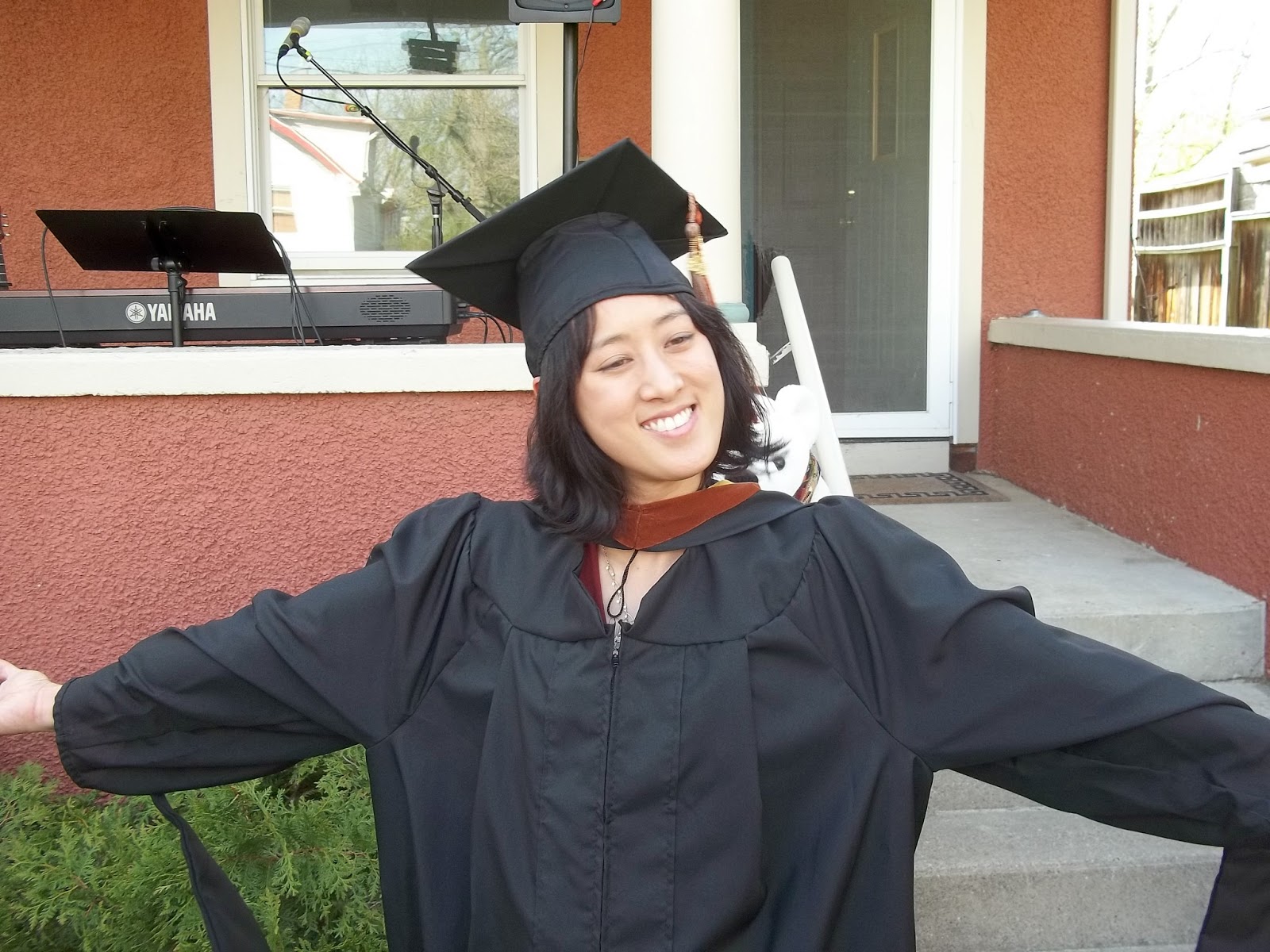
Dressed in the cap and gown she wore Saturday (see above), Teng was her usual ebullient and gracious self. Perhaps because of time constraints, there wasn't much in the way of her usual storytelling. Still, she did get lots of laughs for her line about Michigan's four seasons: Almost Winter, Winter, Still Winter and Construction.
Really, this post is about sharing something with Teng fans not lucky enough to find themselves on her lawn Sunday. I brought my professional Zoom H2 digital recorder to the performance and was situated right between the speakers. So even without "mixing"or doing anything vaguely professional (OK, I did separate the tracks, using Audacity), I got a pretty fair version of what happened on a sunny Sunday afternoon in southeast Michigan.
I've created a RAR file, which you can download and extract with a program like the RAR Expander.
For those who prefer uncompressed/lossless WAV files, I have uploaded the recording to the Internet Archive at Archive.org here. (You can also – if you prefer – download the individual songs at this site)
Finally, here's the video of Teng performing "Boy At the Piano," a song she wrote during her high school days. The video comes from a point and shoot camera and the audio from the Zoom H2. Hopefully, I synced them right.
Tonight, I consider myself the luckiest man on the face of the earth.
Sorry to break the three-year silence on this blog by shamelessly cribbing Lou Gehrig's farewell speech. But that's truly how I feel right now.
I never got a chance to be on that London rooftop when the Fab Four were jamming with Billy Preston on "Get Back;" hang out at Ardent Studios in Memphis when Alex Chilton first started making musical magic with Chris Bell and the rest of Big Star; or even watch while Tim Davis, Steve Miller and Nicky Hopkins put the finishing touches on my all-time favorite song, "Your Saving Grace."
But at least I can say I was in a small second-floor room on Ann Arbor's South University Avenue with only about two dozen others, watching one of my favorite musicians Vienna Teng play a solo set that was so intimate and warm that I feel like I was invited to her private party.
I've written about Vienna in the past. But the truth is, I haven't seen her perform in a few years – partly out of life getting in the way and partly because Teng decided a few years ago to nearly shelf music and become a graduate student at the University of Michigan's relatively new Erb Institute, a collaborative effort of the school's business and natural resources school to develop sustainable technology that also makes economic sense. For the last few years, Teng has lived just a few miles from me in my adopted hometown.
Tonight, just three weeks before graduating, Teng performed a show that she quietly announced on her Facebook page as a benefit for the institute's new collaborative space – the spot where she performed with just her Yamaha electric keyboard and her inimitable self.
In a few earlier blog posts, I've described myself as a kind of real-life version of "High Fidelity"'s Rob Gordon: Someone whose "glory days" in music have long since passed, but still manages to keep an ear out for the newest things – and yes, make mix CD after mix CD.
I don't know if I've made a mix CD in the last few years for a new or old friend that hasn't included a Vienna Teng song.
"You've got to hear this woman," I'll usually say. "No one else sound like her. She's amazing."
Tonight was a rare opportunity to worship at the altar of Vienna Teng in a way that few others have had the privilege of doing.
Vienna is a story singer in the sense that almost everything she writes has a fascinating backstory to it. So we got to hear how "Whatever You Want" was inspired by Milton of "Office Space" fame. Or how she endlessly listened to Dolly Parton records so that she could make "City Hall," her ode to California's legalization of same-sex marriage, a semi-country song to thumb her nose at the genre's homophobic tendencies. Or how the "Grandmother Song," which she had us stand up and do with her (see left), was written to both pay homage and gently poke fun at a woman who fled from mainland China to Taiwan to escape the Maoist revolution.
She even responded to comments and questions from the audience – including, ahem, one loud-mouth
who wondered about her beautiful dress in the "Gravity" video (watch it below) or what she thought in retrospect about her 2008 love song to Barack Obama, "Stray Italian Greyhound." (For the record, despite some of the president's loudest left-leaning critics belonging to Teng's green community, she still things he's a good person trying to do his best. But then again, she admitted, she would probably say the same thing about Mitt Romney if he had won)
For years, I've wallowed in Teng's music. Tonight allowed me to take that wallowing to a whole new level. The smallness of the crowd, the intimacy of the space and the warmth of Teng's own personality made the evening truly magical.
Vienna even thanked me for coming afterwards. For years, I've wondered what would happen if I came face-to-face with Paul McCartney, Steve Miller or Suzanne Vega.
I think I now have my answer. I'd act like a bumbling fool, stumble over my words and not know quite what to say.
Ironically, Teng tonight did a combined cover of "Ain't No Sunshine"/"Lose Yourself." I didn't quite throw up like Rabbit from "8 Mile," but sadly nothing even remotely Christgau-eaque spewed forth from my mouth.
Ugh.
That said, if you read this Vienna while you're Googling your name (something you admitted to doing tonight as part of grad-school procrastination. Let me just say: Been there, done that), I'm hopefully better expressing how much tonight truly meant to me.
As promised quite a while ago on this blog, I've delved into Steve Miller's amazing body of work and put together a guide on all of his musical output over the last 40 years.
To find it, however, you'll have to go to the Popdose blog for Part 1 (1967-73).
You'll have to go elswhere to find it. I'll try to sporadically update this blog, but in the meantime, I've just contributed a piece to Popdose's ongoing series "Caught on Tape" about encounters with the greats – and not-so-great – in rock. My piece details my "interview" with the young Red Hot Chili Peppers in Dec., 1984. You can check it out here. And stay tuned for future contributions at this most excellent blog!
We interrupt this regrettable hiatus to update one of the (happily) most popular features on this blog: The unsung hero known as Peter Wood.
As you may remember from some past posts, I had originally posted a video of what I thought was Peter playing "Year of the Cat" with Al Stewart (and several readers had identified as such), but it turned out to be Robert Alpert, another piano player.
Well, we thought we might have unearthed some footage of Peter playing (and I dug up my old photo of Peter from my Year of the Cat album) to help preserve him for Internet posterity. But we're still not sure.
However, thanks to a former rock photographer named Deborah Chesher who knew Peter and has herself written extensively about him on her blog, we know have a definite photograph and some videos of him playing – though regrettably not on "Year of the Cat."
Here's the photo she shot of him:
A little different from the photo I supplied, eh? I'm not sure of the year. But I'm sure Ms. Chesher will supply it if she visits this blog (She happened to have visited a previous test blog where I wrote about Peter. Somehow, that seems to come up on search engines first)
Anyway, if you go to her blog, you'll find a few YouTube videos of Wood performing with other musicians such as Pink Floyd and Lou Reed. I want to direct some traffic Deborah's way, so I won't post them all. But I thought I'd at least show Wood performing with Lou Reed and Robert Quine in 1984, which was around the time I encountered him. The close-ups of Peter's playing come about 7 minutes into the video.
Hang on. This is going to be one heck of a story, beating all my previous "Stories from the War" about my brief foray into the music business.
When U2 released "Pride (In the Name of Love) in 1984 and it became the group's biggest mainstream hit to date, I had mixed feelings as the music director of my college radio station at Georgetown University, WGTB.
I loved the song's sense of urgency and its driving beat. But I wondered how many white suburban kids eagerly snapping up copies of Unforgettable Fire (the album that featured the song) really knew whom Bono was singing about: someone who has always been one of my personal heroes. Remember: This was back before Martin Luther King Day was a national holiday.
So I locked myself in the studio of my college radio station with that record and another LP I had recently acquired that featured audio snippets from 1968 – including coverage of Martin Luther King's assassination on April 4, the subject of the song. Using two turntables and an old-fashioned cart machine, I assembled a crude mix that incorporated King footage, "Pride" and the album's other King-themed track, "MLK "and dubbed it onto an audio tape.
Fast forward to a few months later, I was backstage at U2's concert at Constitution Hall – to interview Mike Scott of the Waterboys, the opening act. Then Bono came into the room.
I must have bee too proud of my work because to this day, I can't believe how brazen I was. I walked right up to him and had him listen to the remix on my Walkman.
He loved it. I mean, he really loved it.
Getting really excited, he had me play it for each one of the other band members and band manager Paul McGuiness, who asked if he could have my tape. It happened to be my only copy, but of course I gave it to him.
The next morning I heard from the college radio guy at Island Records that the tape was all that the Bono talked about during a conference call with the label. They discussed putting it out as a special 12".
Needless to say, that never happened and I never saw the tape again. Nor did I hear anything more from McGuiness or U2.
A few months later, I did another mix at the radio station. Unfortunately, the timing isn't as perfect and some of the audio clips should be louder – but you get a sense of what I was able put together. All the clips double the impact and make the song an amazingly emotional experience, Bono's historical inaccuracies and all. I dubbed it onto a TDK D-90 cassette tape and took it with me when I graduated.
A few years ago, I dug the cassette out and did an mp3 rip. Not perfect, but now at least I had something that would survive longer than that lower quality cassette.
Still, the inferior quality of the second remix bugged me. Plus, as I listened to it more, I thought there could have been more audio clips from Martin Luther King himself. If I could go back in time, I'd redo it – which of course was a big old fantasy, much like that wide receiver who drops what could have been the winning pass in a championship game.
Then technology opened the door for me. The advent of a simple software program like GarageBand meant that I didn't need turntables any more. In fact, I could be more precise than I was back in my college days. Plus I had acquired some vinyl-ripping hardware. I started scouring used record shops, looking for that record.
The only problem was: I had no idea what it was called, other than it had to with 1968 and was put out by some Chicago news radio station. My odds of finding that record were pretty slim, I realized. In one last ditch attempt, I even contacted my old radio station – although they had transitioned out of LPs a long time ago.
Was I completely out of luck?
Nope. Ever hear of sites called Google and eBay? That's right. By some blind luck on the same day, I was able to pinpoint the name of the record with a few random terms plugged into Google: "Chicago," "1968," "record" or something like that. The record was called "1968: The Impossible Year" and was put out by WBBM in Chicago in conjunction with a local savings bank. Here's what it looks like and you can even still buy it on eBay, if you're interested.
So now I had it: What was I going to do with it?
Well, things repeatedly got in the way – as life always does. But a few weeks ago I was inspired: Wouldn't this January be the perfect time to put something together to honor how far we have come since April 4, 1968. More than 40 years ago, this nation mourned the death of its first transformational African-American leader. On Jan. 20, the day after Martin Luther King Day, possibly the nation's next transformational African-American leader will take the oath of office for the Presidency – something few civil right leaders, including King himself quite likely, would have thought could have happened so quickly after all that 60s bloodshed.
Here is my new remix. I've done some research about who is talking and when. I knew right away that the music dedication was from Duke Ellington, who was performing at Carnegie Hall that night. The announcement of King's death was done before that concert by its promoter Robert Mosley. You can read an excellent firsthand account from one of the concert's participants here. Excerpts from two King speeches were used: The famous "I Have A Dream" speech and the chillingly prophetic "I Have Been to the Mountaintop" speech in which King eerily talks about his mortality the night before his death. I increased the volume of the audio clips and sprinkled them throughout the song.
I'd love to hear your thoughts on which mix works better for you. Although I really like the new version, it wouldn't surprise me if some people preferred the original mix.
It's true that whites now know who Martin Luther King is. Given the band's increasing social activism, the majority of U2 fans are also quite familiar with the true subject of the song. On Sunday, January 18, two days before the inauguration, U2 performed "Pride (In the Name of Love)" on the steps of the Lincoln Memorial. "On this spot, 46 years ago, Martin Luther King had a dream," Bono told the large crowd, gathered for a pre-inaugural concert that also featured Sheryl Crow, Bruce Springsteen, Stevie Wonder and Shakira. "On Tuesday, that dream cones true."
Keeping with the spirit of what motivated me, I created a slideshow "video" of the song and posted it on YouTube. You can see it here. Be sure to watch it until the end.
Sorry about the delay, but here is the picture I promised: From the gatefold of my vinyl copy of "Year of the Cat." Sigh. They just don't package albums like they used to.
Here's another few clips of Al Stewart performing "Year of the Cat" live. I'm bad with faces (which explains why I got it wrong with the first clip) so can anybody help me judge whether any of these features the late, great Mr. Wood?
In any case, thanks for all the great comments. I never imagined that the original post could spur such discussion – and bring so many great people to this blog. Thanks so much.